


Most of a wind turbine blade’s strength and stiffness come from the glass reinforcement set in resin, and the reinforcement choice shapes how the blade performs over its life. Fiberglass for Wind Turbine Blades is selected for the shell, the spar and the root, where each area carries a different load. ZS Fiberglass produces the fabric, mat and combo products referred to in this guide. Core materials and the aerodynamic profile fall outside its scope, which covers how the reinforcement is specified, processed and verified.
Overview Of Composite Materials Used In Wind Turbine Blades
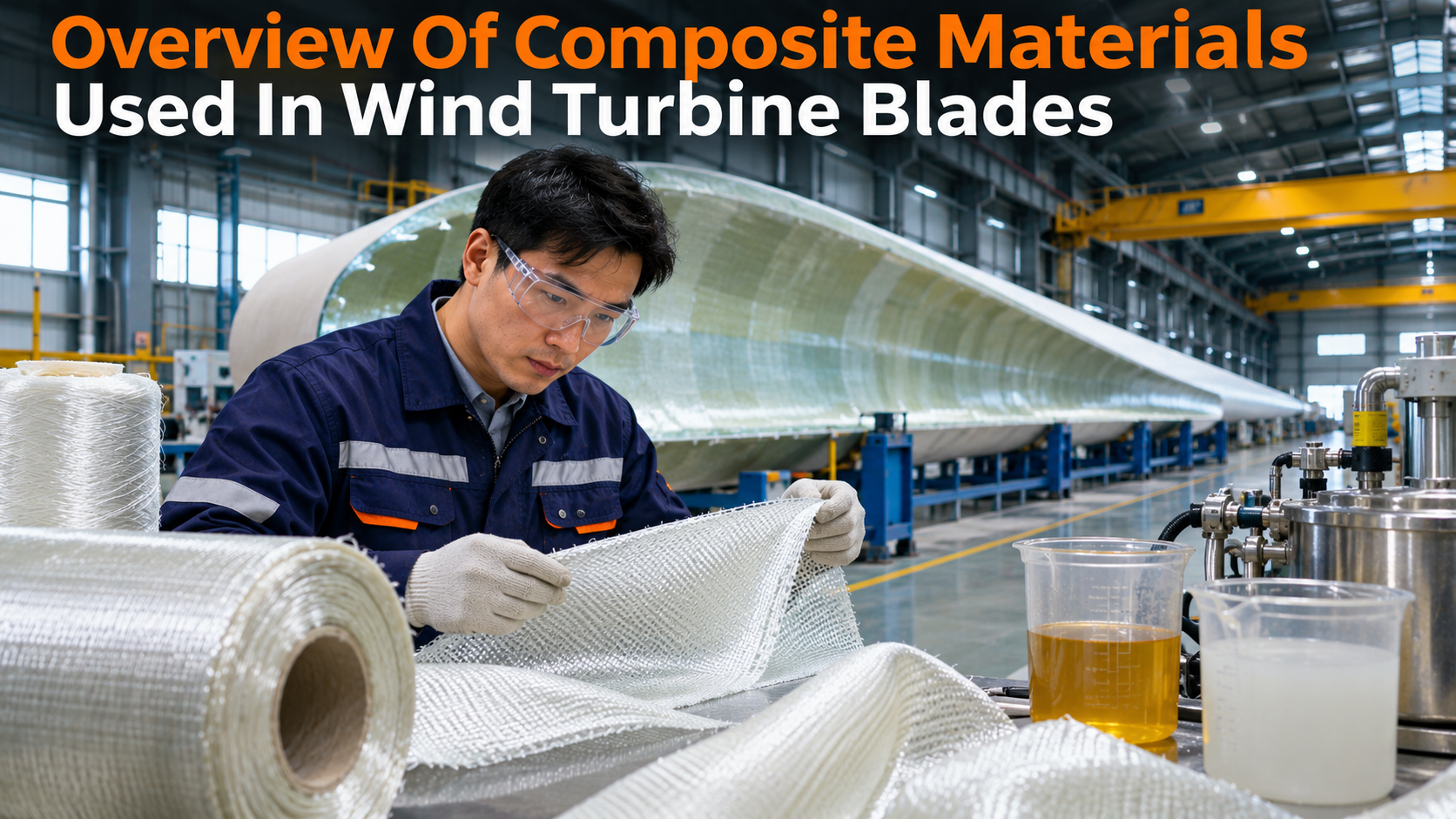 Overview Of Composite Materials Used In Wind Turbine Blades
A blade combines a fiber reinforcement with a resin matrix. The reinforcement carries the load, while the resin holds the fibers in place and transfers stress between them. Polyester, vinyl ester and epoxy are the common resins. Among the reinforcements, fiberglass for wind turbine blades is the most widely used because it balances strength, weight and cost. The reinforcement must match the resin system, and the resin ratio must be controlled before application, so confirm the pairing on a test laminate before production.
Structural Requirements Of Wind Turbine Blade Components
 Structural Requirements Of Wind Turbine Blade Components
Blades face cyclic loading for decades. Wind bends the blade flapwise, the rotor loads it edgewise, and the blade twists under load. Each component has a different main requirement. The shell needs shear and torsional strength, the spar needs bending stiffness along the blade, and the root must carry concentrated loads into the hub.
Fatigue is the defining requirement. ASTM D3518 measures in-plane shear response by tension testing a laminate with fibers at ±45°, which is why shear performance is commonly tested on that layup. The blade designer sets fiber orientations, layer sequence and fatigue targets, so the supplier’s job is to deliver the specified construction consistently.
Fiberglass Reinforcement In Blade Shells, Structural Sections And Composite Laminates
 Fiberglass Reinforcement In Blade Shells, Structural Sections And Composite Laminates
Each section uses a different construction. When the shell is built, fiberglass for wind turbine blades usually includes biaxial cloth at ±45°, which carries shear and twisting. Biaxial cloth runs from 300 to 1200 g/m², with an angle adjustable from +30° to +80° and widths up to 101 inches. The 1708 combines 17 oz/yd² of ±45° fabric with a 0.75 oz/ft² stitched mat, which builds thickness in one pass. Its ECR variant is intended for chemical service, which blades rarely face, so standard E-glass is usually the right grade.
Unidirectional cloth places 150 to 1200 g/m² in the 0° direction, which suits spar caps that carry bending along the blade. Triaxial cloth, running from 450 to 2000 g/m², adds a third direction for roots and load transitions. Multiaxial layers are stitched with polyester yarn, so they stay non-curling during lay-up.
How Fiberglass Supports Strength, Weight Management And Durability
The strength that fiberglass for wind turbine blades delivers depends on fiber direction and straightness. Fibers at ±45° resist twist that 0° and 90° layers handle less directly, and non-crimp layers avoid the bending of fibers over and under each other, so load transfers without first straightening the fibers. NREL-reported fatigue testing of laminates with 0° and ±45° layers found that fatigue resistance depended on fiber content and on the share of ±45° reinforcement, and that it fell short of expectations at high fiber contents and high ±45° shares. The angled share is therefore a design decision, not a default.
Weight is managed through glass grade and resin use. S-glass is about 35 percent stronger than E-glass with 10 to 20 percent higher modulus, but its test basis is not published, so request the data first. The 1708 is also claimed to reduce resin use by up to 30 percent compared with woven roving. That claim has no published comparison basis, so test a panel of each build before relying on it. Durability depends on the resin and construction together, so confirm both.
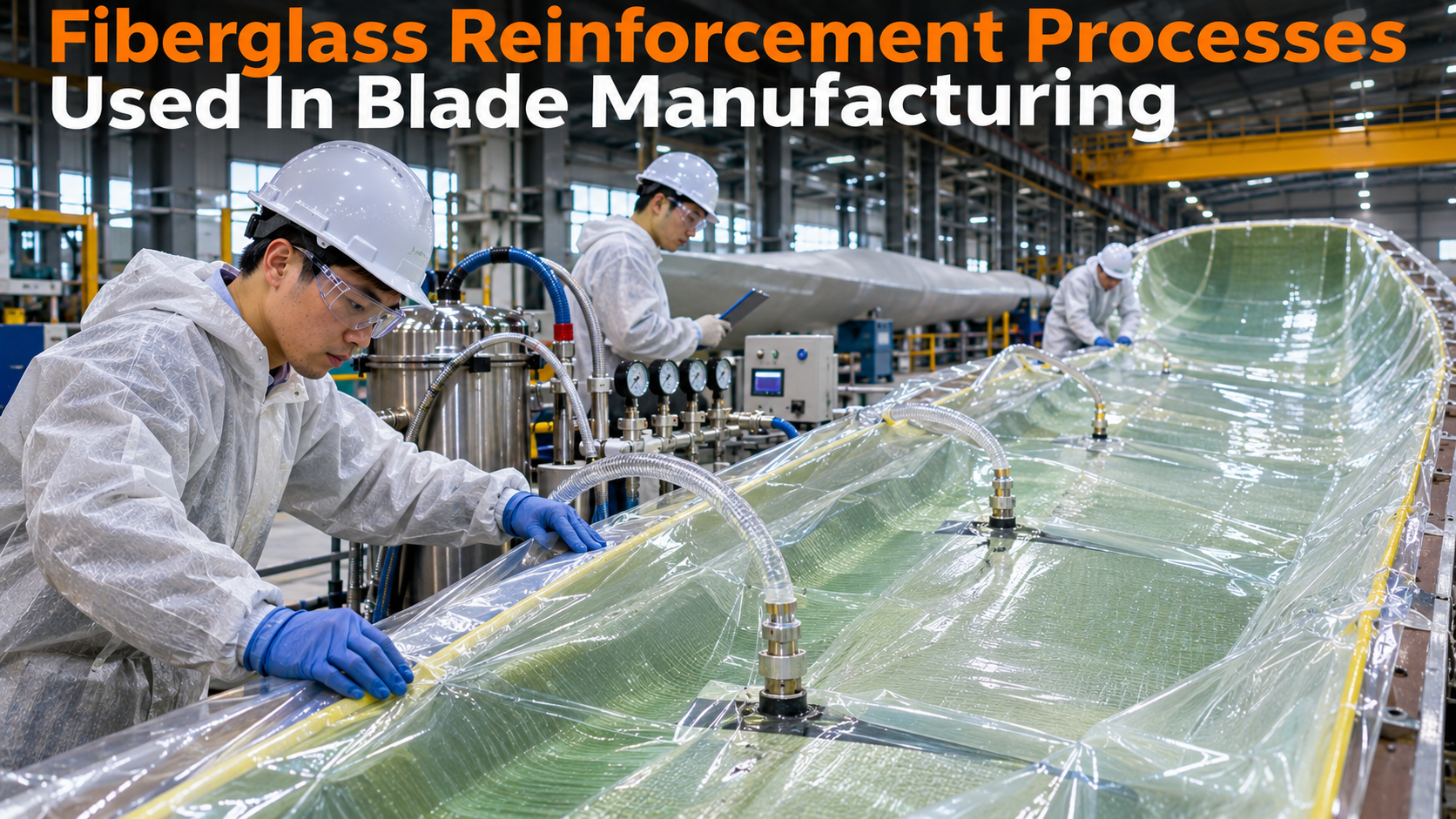
Fiberglass Reinforcement Processes Used In Blade Manufacturing
Blade manufacturers use hand lay-up for some parts and vacuum infusion for others, and the reinforcement must suit the process. Process choice also shapes fiberglass for wind turbine blades, since chopped strand mat and combo mat suit hand lay-up, where the mat layer adds bulk and gives resin a path through the stack. Stitched mat has no binder, so resin contacts the glass directly, which suits infusion. Continuous filament mat is compatible with unsaturated polyester, epoxy and polyamine resins and is used in resin transfer molding and vacuum molding.
Infusion is sensitive to construction. Weave and fabric weight change fiber and void volume, so run a test panel in the actual process before ordering rolls for a blade. Stitch tension matters too. The 1708 is described with dynamic tension sensors during stitching to limit puckering and fiber waviness, which matters when a flat layer must sit correctly across a long mold.
Material Requirements For Wind Energy Component Manufacturers
Buyers of fiberglass for wind turbine blades should specify each layer as a line item: construction type, fiber angle and tolerance, weight and tolerance, glass grade, stitch pattern, width and resin system. Request a data sheet for the exact product and batch records that trace each roll to its yarn. The yarn sets the properties of the finished cloth, so ask whether the same plant draws, twists, weaves and stitches the reinforcement. ZS Fiberglass states that it draws its own glass and makes its yarn in house, which makes that traceability question easier to answer.
Slitting matters for blades. The 1708 is available slit from 4 to 100 inches, and the locked edge keeps narrow tapes from unraveling during handling. Request certificates for the exact product. CE, UL, TUV, ISO9001, RoHS, BSI and EN 13501 approvals are listed for the range, and each covers something different, so match each certificate to the test it claims.
Challenges In Fiberglass Reinforcement For Large-Scale Wind Turbine Blades
Scale is the main challenge for fiberglass for wind turbine blades. Long blades need wide, flat layers that stay straight across the mold, so tension control and edge stability decide whether a layer lands correctly. Thick laminates need resin to reach every layer, which makes wet-out and void control central. A fiber angle chosen for strength can reduce fatigue margin if its share is too high, so the layup needs engineering review, not only supplier selection.
Surface finish is another challenge. Fiber texture can print through the cured surface, and the fine-surface 1708 adds an ultra-thin tissue on its face to reduce this. Inspect a cured sample under suitable light before committing to production quantities.
FAQs
Is ECR Glass Needed For A Wind Turbine Blade?
Usually not. ECR glass is intended for acid leaching and alkaline attack, which matters in tanks and scrubbers. Blade specifications normally call for E-glass, but the designer should confirm the environment and resin system before choosing a grade.
What Warranty And Lead Time Apply To Blade Reinforcement?
The stated terms are a one-year warranty on fiberglass materials and a 15-day lead time for raw materials, with 30 percent deposit and 70 percent before loading for new customers. Custom lead times and warranty coverage should be confirmed separately.
How Quickly Can A Buyer Get A Sample?
Free samples are quoted at about three days, and customized samples within about two weeks. Request the exact layup and width you plan to use, so the sample tests the product you will order.
Do Onshore And Offshore Blades Need Different Reinforcement?
The product information does not separate them. Loads, environment and service life differ, so the blade designer should set requirements for each site, and the supplier should confirm the chosen construction meets them.


