


Biaxial fiberglass cloth is the right choice when a part has to resist twisting or shear and you want those fibers in one layer instead of several rotated plies of woven fabric. Two questions settle most purchases: which load the part carries, and how much weight each layer needs. This guide covers the benefits, the applications and the reason each one calls for biaxial fiberglass cloth, how to convert and choose the weight, and what to check before ordering. ZS Fiberglass makes biaxial cloth and its 1708 combination, so the details below come from that range.
Core Benefits Of Biaxial Fiberglass Cloth
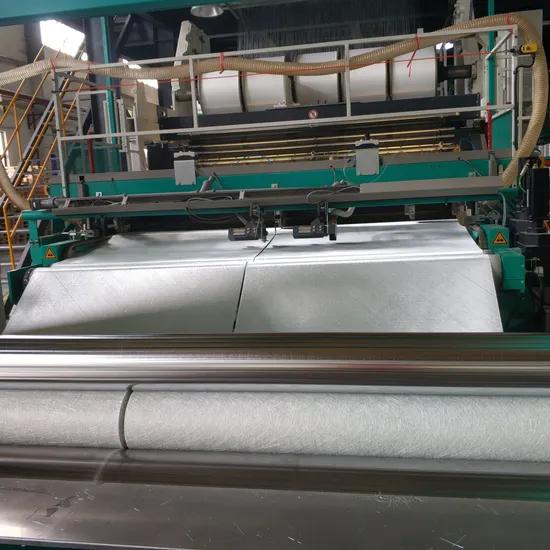 Core Benefits Of Biaxial Fiberglass Cloth
Resistance to twisting and shear: Fibers at ±45° line up with the directions in which twisting and shear loads act, which 0° and 90° layers handle less directly. The ASTM D3518 test method uses the same logic, measuring in-plane shear response by tension testing a ±45° laminate.
Flat-laid, non-crimp fibers: The fibers are not bent over and under each other as they are in a weave, so load transfers without first straightening the fibers. Tension is controlled during stitching to keep the layer flat.
Two directions in one layer: One layer carries both ±45° directions, so you avoid cutting, rotating and placing several woven plies.
Stitched, not glued: Polyester stitching holds the layers together without a chemical binder, and biaxial fiberglass cloth works with epoxy, polyester and vinyl ester resin. Confirm wet-out on a test panel.
More ±45° is not always better. NREL-reported fatigue testing of laminates with 0° and ±45° layers found that fatigue resistance depended on fiber content and on the share of ±45° reinforcement, and that it fell short of expectations at high fiber contents and high ±45° shares. The ±45° share is a design decision.
Applications And Why Each Uses Biaxial Cloth
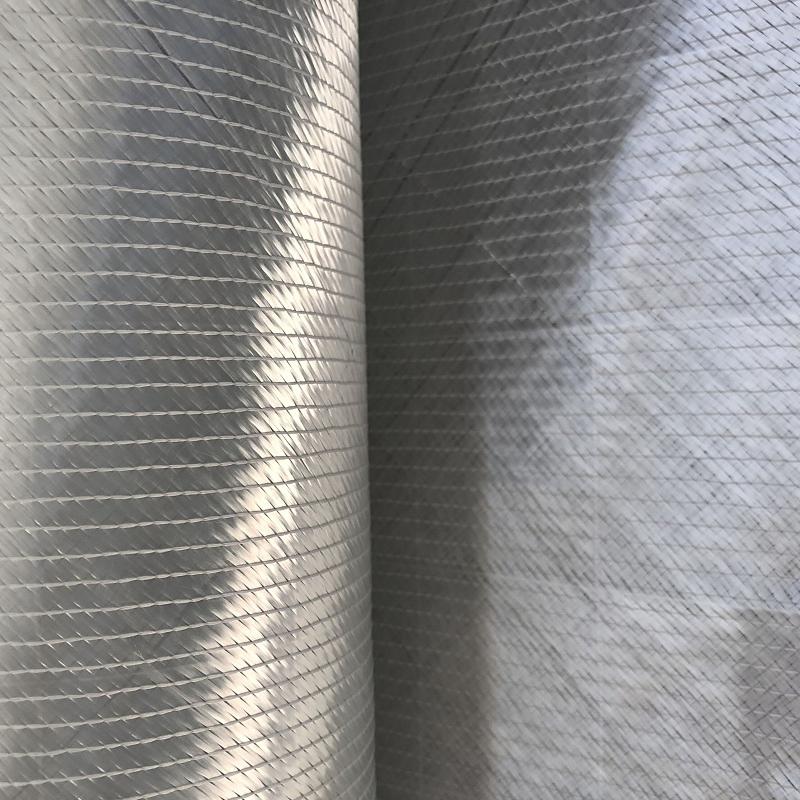 Applications And Why Each Uses Biaxial Cloth
Boat stringers and hulls: Waves, flexing and docking loads twist the hull, and the ±45° fibers carry the shear from those loads. The mat layer in the 1708 adds thickness in the same pass. Narrow tapes slit from the roll can wrap stringers without unraveling, thanks to locked-edge stitching.
Wind turbine blade spars and roots: Blades face continuous cyclic loading, and non-crimp fibers avoid the crimp where micro-cracks tend to start. The blade designer still sets fiber angles and layer sequence, so biaxial fiberglass cloth is one input to the schedule, not the whole specification.
Automotive and transport panels: Racing bodies and heavy truck panels need stiffness and impact resistance at controlled weight. The flat fiber layout spreads impact energy, and the mat layer adds bulk without a separate mat placement.
Chemical storage and scrubbers: ECR-glass resists acid leaching and alkaline attack better than standard E-glass, which makes the 1708 suitable for tanks and scrubbers. Resin and surface layer still decide service life, so check them against the chemicals in service.
How To Choose The Right Weight
 How To Choose The Right Weight
Biaxial cloth is quoted in two units, so the first step is to put both on the same scale. To convert ounces per square yard to grams per square meter, multiply by 33.9. To convert ounces per square foot, multiply by 305.2.
Standalone biaxial cloth runs from 300 to 1200 g/m², with an angle adjustable from +30° to +80° and widths up to 101 inches. The 1708 combines 17 oz/yd² of ±45° fabric, about 576 g/m², with a 0.75 oz/ft² stitched mat layer, about 229 g/m². Variants change only the mat layer.
| Option | Mat Layer | Mat Weight | Choose When |
| Standard biaxial cloth | None | Not applicable | The mat will be placed separately, or the part needs a thin build |
| 1705 | 0.5 oz/ft² | About 153 g/m² | Thinner, lightweight profiles such as surfboard and sculling parts |
| 1708 | 0.75 oz/ft² | About 229 g/m² | Thickness build and resin flow in one pass, such as boat stringers |
| 1715 | 1.5 oz/ft² | About 458 g/m² | Impact-prone panels that need more bulk |
The fabric weight of the 1705 and 1715 variants is not stated in the provided material, so confirm it on the data sheet before comparing total weights.
Plain, twill and satin weaves do not apply to this construction. Biaxial layers use straight fibers at set angles rather than woven yarns, so the weave comparison used for woven cloth does not transfer here.
Work through the choice in this order. Set the target laminate thickness, check that the load direction suits a ±45° layer, then pick the mat option that reaches the thickness with the fewest layers. Check that the total weight stays within the range for your angle.
Buying Checklist For Procurement Teams
Before ordering, confirm the angle and its tolerance, total weight and tolerance, mat weight, glass grade, stitch pattern, and width or slit size. Write each weight in both units and check that the quote and data sheet use the same one. Ask for the test method behind each figure.
ZS Fiberglass cites a 1708 resin saving of up to 30 percent compared with woven roving, but the comparison basis is not published, so test a panel of each build before relying on that figure. The company also cites dynamic tension sensors during stitching, slitting from 4 to 100 inches, and a 10,000-ton annual capacity. The capacity figure should be checked, since the company’s other pages give different numbers. Custom widths, weights and mat layers are available. For raw materials, the stated lead time is 15 days and the warranty is one year. New customers pay 30 percent deposit with 70 percent before loading.
FAQs
How Should The Cloth Be Oriented Relative To The Part?
Set the ±45° directions relative to the part’s main axis so they line up with the twisting load. Confirm the orientation with the laminate designer before cutting.
How Do I Check A Sample Before A Production Order?
Check weight, width and stitching against the data sheet, and inspect flatness and edge stability. Then laminate a test panel in your own resin and look at wet-out and voids.
How Do I Estimate Waste When Slitting To A Tape Width?
Calculate the offcut from your own tape widths. Cutting a 30-inch tape from a 40-inch roll leaves a 10-inch strip, which is 25 percent of the roll width, while a roll slit to 30 inches leaves only the edge trim.
When Is A Custom Angle Worth Requesting?
When the load path is not close to ±45°, such as a shell with off-axis loads. The angle can move between +30° and +80°, but a custom angle needs an engineering basis and a longer lead time than a standard roll.


